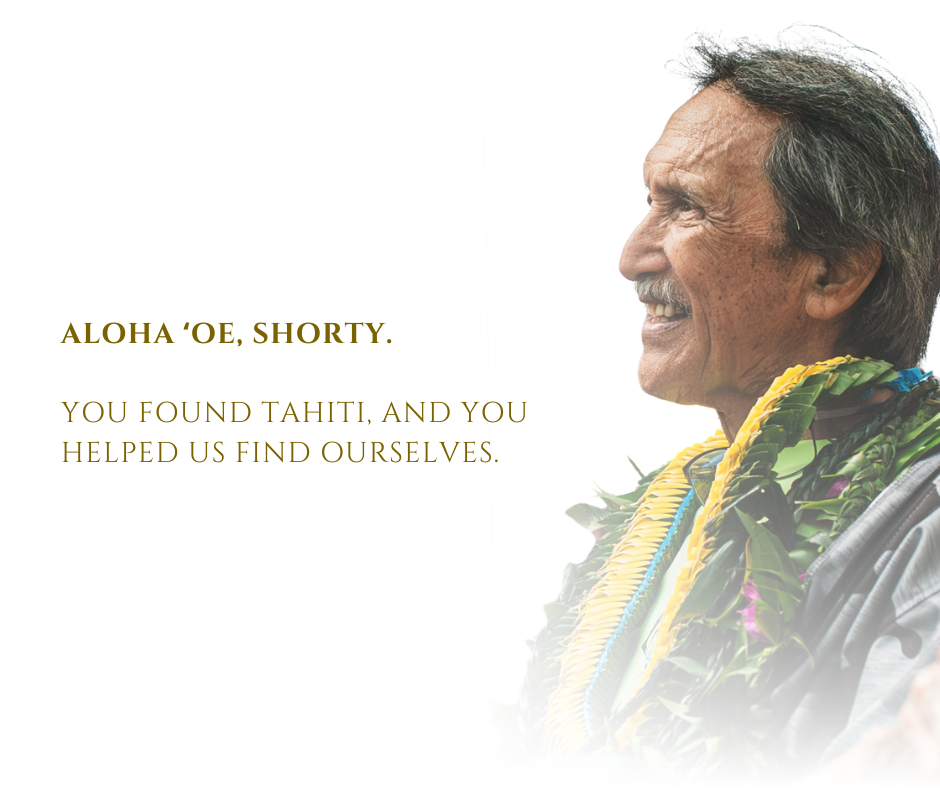
A Tribute to Pwo Navigator Milton “Shorty” Bertelmann
________________________________
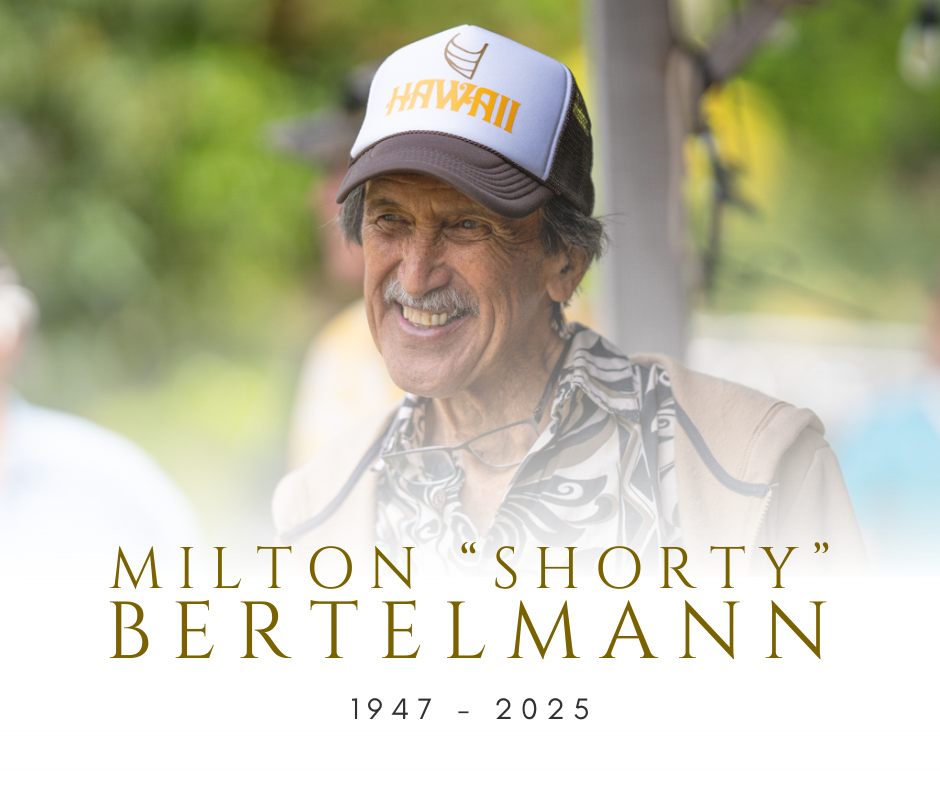
A Tribute to Pwo Navigator Milton “Shorty” Bertelmann
From the Polynesian Voyaging Society
The Polynesian Voyaging Society honors the life, leadership, and enduring legacy of Pwo Navigator Milton “Shorty” Bertelmann, a foundational leader of Hōkūleʻa and a quiet pillar of the Polynesian voyaging renaissance.
From the earliest days of Hōkūleʻa, Shorty stood at the heart of the mission. Beginning in 1975, as Hōkūleʻa first sailed throughout the Hawaiian Islands recruiting crew members, Shorty committed himself fully to the care of the canoe, the discipline of the crew, and the deeper purpose of restoring traditional voyaging knowledge. In 1976, Shorty was selected from among dozens of highly capable candidates to sail on Hōkūleʻa’s historic maiden voyage from Hawaiʻi to Tahiti, a journey that reawakened traditional Polynesian voyaging and forever changed our understanding of who we are as Pacific peoples.
And it changed Shorty. His selection was no accident. Shorty possessed extraordinary leadership qualities: quiet, unwavering, and deeply grounded. He understood why he was there and never lost sight of it: to care for Hōkūleʻa, to protect and support Mau Piailug, to learn traditional navigation, and to help ensure that the canoe found Tahiti.
Central to Shorty’s legacy was his profound relationship with his teacher Mau Piailug. Shorty approached navigation with humility and absolute focus, recognizing the rare and sacred opportunity to learn from a master. Mau, in turn, recognized Shorty as a true student, one who listened, observed, and committed fully. Their teacher–student relationship became historic, representing one of the first times Micronesian navigational knowledge was shared beyond its homeland. That bond succeeded because Shorty wanted to learn, and Mau was willing to teach. Shorty protected Mau, held sacred the teachings of Mau, upheld the strict standards of conduct Mau lived by, and ensured that the space around him remained respectful and focused.
Shorty remained deeply committed to the mission beyond that first voyage and emerged as one of Hōkūleʻaʻs most trusted captains. He went on to serve on and captain several pivotal voyages and was instrumental to their success and to the continued growth of the voyaging movement across the Pacific.
In 1980, he sailed again from Hawaiʻi to Tahiti on a demanding 31-day voyage marked by relentless weather and immense physical and mental challenges. Once again, he was an integral part of the crew to help ensure the success of the voyage, he continued his deep desire to study navigation and was also important to the integrity of the navigation.
In 1985, Shorty captained critical legs of Hōkūleʻaʻs maiden voyage to Aotearoa, including the journey from Rarotonga, Cook Islands to Waitangi, New Zealand, the first deep-sea leg without Mau on board. It was a difficult and deeply spiritual leg of the voyage, marked by extraordinary moments at sea. Shorty was the captain the canoe needed. He was thorough in preparation, exacting in training, calm under pressure, and steady in spirit. Everyone trusted him. His leadership carried the canoe safely through uncertainty and into new horizons.
Shorty continued to serve as captain on numerous significant voyages, including bringing Hōkūleʻa home from Aotearoa in 1987, and later captaining the voyage to the Cook Islands in 1992. Across these journeys, he raised the bar of excellence for voyaging, establishing rigorous standards of training, safety, preparation, and conduct that remain foundational today.
He was known for staying awake long hours, checking everything, paying attention, not only to the canoe, but to what nature was doing to her. In his quiet way, he was always present. He was kind, but firm. He rarely needed to speak expectations aloud, but everyone felt them. He held himself, and everyone around him, to the highest standard: care for the canoe, care for Mau, care for one another, and succeed together.
Behind Shortyʻs steadiness was a life shaped by profound experiences. Shorty served in the Vietnam War, a chapter that deeply affected him. Those who knew him understood that the war left lasting scars, and that when Hōkūleʻa returned home in 1992, Shorty carried both the weight of that history and the toll of years of intense commitment. He pulled back quietly, as he lived by never seeking attention, never asking for recognition. But, his impact never diminished.
Shorty helped lay the foundation for everything Hōkūleʻa stands for today, and from his character emerged our voyaging values: the canoe is your home, the crew is your family. These principles became embedded in the culture of Hōkūleʻa and later carried forward into journeys such as the Worldwide Voyage. He taught us that finding islands begins with caring for your home and your family and that through discipline, humility, and commitment, navigation becomes a way of life. His leadership, integrity, and devotion to the mission shaped the voyaging renaissance in Hawaiʻi and throughout the Pacific. He showed us that true leadership does not need volume or rank. It needs clarity of purpose, discipline of action, and unwavering commitment.
We honor and thank Shorty for who he was, for what he gave, and for the standards he set that continue to guide us. His spirit will forever be felt on the deck of Hōkūleʻa. His leadership remains our compass and his legacy lives on in every voyage, every crew member trained, and every horizon crossed by Hōkūleʻa.