Crew Reflection: Mataiea Is Full of So Much Passion, Aloha, Laughter, and Makana
Ia orana!
It is Wednesday, July 9th. I am on the deck of the Hōkūleʻa, sitting on a black pelican case typing on the keyboard, searching for the words to describe the experience we have had in Mataiea over the past few days. We never could have anticipated the experience we would have here, a place most of us had never heard of – on the schedule it looked like a short stopover before the highly anticipated stay in Mo’orea.
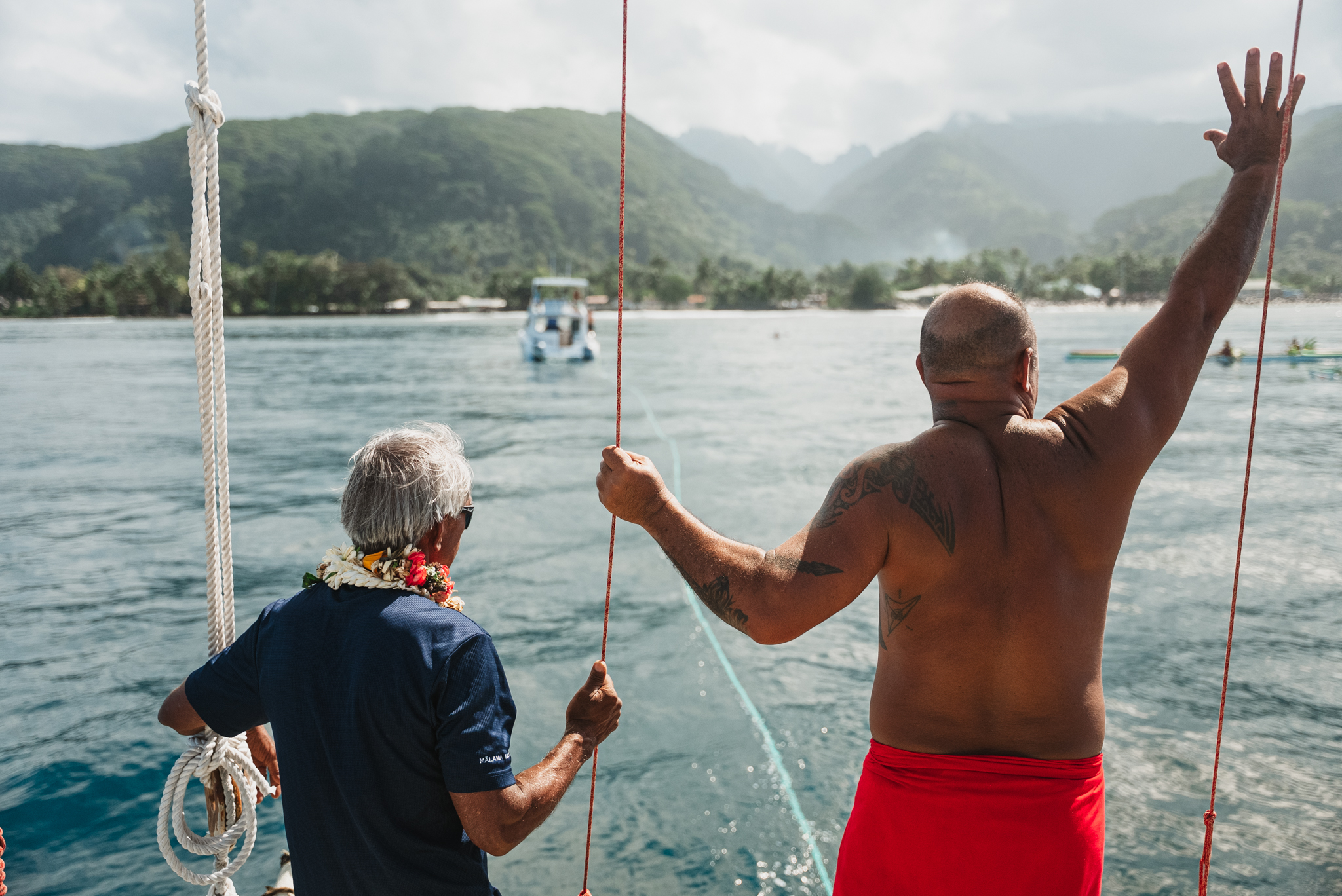
We left Pape’ēte, heading for Teva i Uta in the dark of Sunday’s early morning. We could hear the last of Heiva’s dancers and supporters in the distance, bumping beats from stereos, holding onto the night’s performance, until sunrise. We pulled out of the channel, on tow, and made our way to the west and around to the south of Tahiti Nui. The ocean swells were evident, and the power of these swells became more visible as the sun rose and we could see the thick fog of ‘ehukai along the coastline.
All we knew about where we were headed was that the Paoa family was hosting us, and they were passionate about making sure Nainoa and the canoe he has sailed on for 50 years came to their homeland, particularly the marae (heiau) of the Paoa Family, named “Aputera’i” (apu=dome; tera’i=sky). Nainoa comes from the Paoa line, Duke Kahanamoku comes from the Paoa line, and my husband comes from the Paoa line of Rapa. I was hoping to build pilina with this ‘ohana who share a distant bloodline with my husband and daughter.
The crews of Hōkūle’a and Hikianalia had already participated in a welcome ceremony at the marae, “Ivirau To’omaru” on our way to Fare Hape in Papeno’o Valley. Many have also experienced welcoming ceremonies in Hawai’i, and a few of us have experienced powhiri in Aotearoa. We thought we were prepared for this, another Polynesian welcoming, but we were fully unprepared for the type of welcoming ceremony we were about to experience. The first hō’ailona that this would be different, was the welcome into ‘Aifa pass marked by a strange and powerful cloud formation in the shape of nine cresting waves. As we waited for Nainoa and PVS navigator Lehua to motor to us, a police boat came buzzing out with a local Tahitian priest aboard who began yelling at us, not with a warm “haere mai,” but a demanding yell – all we understood in the Tahitian he roared was “Where is Nainoa? Where is Nainoa?” We began to feel that we would not be welcome to enter the pass without Nainoa on board. Kaleohano handled the traditional oratory duel with composure and explained that we are the crews of Hōkūle’a and Hikianalia and that Nainoa was coming. We were relieved when Nainoa was spotted on his way and safely made it on board with his daughter, Puana, and Lehua.
As Dino and Makana took hold of the hoe uli and we headed into ‘Aifa Pass, we were flanked by breaking waves, on each side, over 8 feet high, as well as more than 50, 1-man, 6-man, and 12-man canoes. Jetskis were positioned near the reef marking our boundaries. We felt angst as Allen called out the timing of each arriving swell and felt the exhilaration as Mama Hōkū rode the waves through the pass with locals chanting and calling us from shore. We safely brought her to dock and quickly gathered ourselves for the walk mauka to the marae.
As we passed a few homes we came to what felt like the opening of a small clearing, the marae was not initially visible, and before it came into view we were faced with something none of us had ever seen before. Spread out in front of us were about 20 women in solid red, covered with capes made from strands of hau, hair in high ponytails, and painted black lips. With intensity in their eyes they began yelling at us in Tahitian. They took the man we thought was hosting us through the protocol and pulled him behind them, leaving us feeling exposed and confused. A few of the women had traditional weapons in their hands, yelling with anger; we felt confronted and unclear when and how to respond.
I was holding a ceremonial gift, a traditional Rapa Nui weapon which was used in ancient times by the Paoa Family, those tasked with enforcing the rules and tapu of the ariki. The name of this weapon is He’ua o Paoa and was carved by my husband, as a gift for his distant relations. The 2-3 foot wooden baton-like weapon has a double sided face carved into the top end – this one was carved with koa wood from Hawai’i. I tried to hold the weapon as peacefully as possible, covering the tip with my hand, and at one point felt like dropping it. I did not know what to do, and for what was uncomfortably long, the captains in front of me also did not seem to know what to do. The wahine yelling in front of us ranged from about 8 years of age to 70. One of the young women leading the intense oration took her ko’i (adze) and thrust it into the ground, just about 2 feet from my and Maleko’s feet. Maleko started shaking his head and was the first to reach his voice out, to try to calm what in the moment felt like chaos. In ‘ōlelo Hawai’i he explained that we were the crew of Hōkūle’a and Hikianalia, and we arrived with aloha. Soon after, someone in the small crowd of locals behind and to the side of us started laughing at the scene unfolding – the younger wahine leading went wild. I didn’t know exactly what she was saying, but I knew she was yelling at the person who was belittling their ceremony. I was concerned that she would think the laughs came from our group.
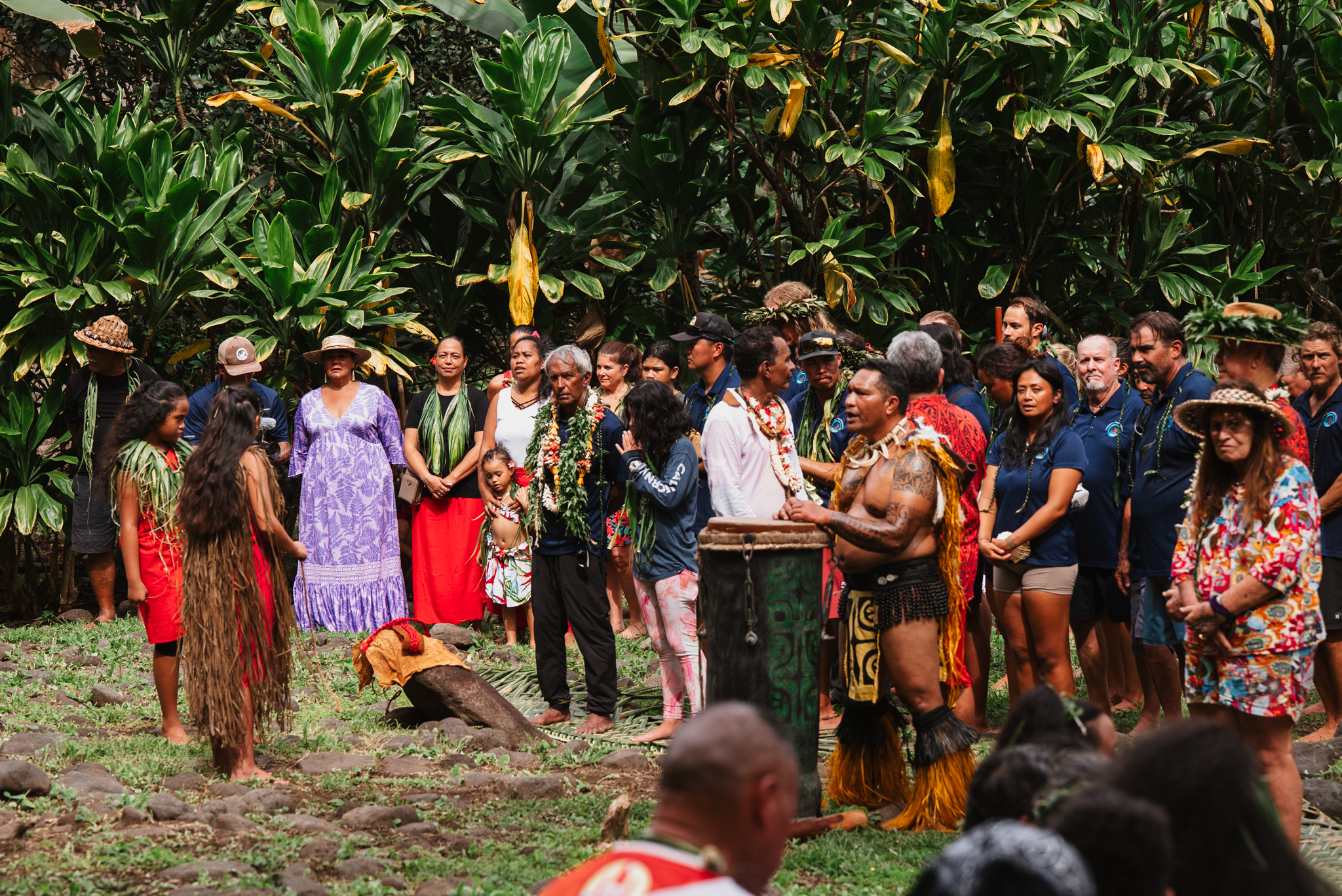
As the scene continued to unfold, someone from Tahiti said, “You need to introduce yourselves. Introduce yourselves!” Jonah then, in simple Hawaiian, introduced himself and where we are from. Maleko also introduced that Nainoa is a Paoa. It was the key we needed to unlock the true welcome to this special place. The kupuna wahine leading the ceremony stepped forward and her face softened, her eyebrows peaked, and she said “Ahhh Paoa! Mai. Mai.” We were now allowed to enter. The tension in my body, and the fear in my heart left. I was still uneasy, and felt some worry that we were not properly prepared for what was going to happen and what we had to do, but one at a time we walked forward, taking off our shoes and washing our feet with wai before entering the marae. At the top of the sloped marae was a kupuna kane with tattooed legs and large feathered headdress, and another male on a pahu; until this point, the males were not directly involved in the ceremony. There was a Paoa stone they positioned Nainoa and Puana in front of, the rest of us behind. Two small girls, about nine years of age came forward to do a short welcome in Tahitian, then three women shared with us their genealogy. Songs were shared and chants filled the canopy around us. A butterfly fluttered around near us and Nainoa felt it was his grandmother.
Before the presentation of the stones from Nainoa’s family, they asked me to step forward and present the gift from my husband. In a mix of the ‘ōlelo Hawai’i and re’o Rapa Nui that I know, I explained what the weapon was made by my husband, Paolo Benjamin “Matariki” Cardinali Tuki, grandson of Vinapu Paoa of Rapa Nui. They asked my name, I said “Starr Johnson Tuki” and they asked again, I repeated, and they asked again, so I said “Hoku Johnson Tuki” and the kupuna wahine said “Ahhhh Hoku!” She then presented me to the seated choral group in red as “Hoku.” They restarted their chanting, integrating “Hoku” into the melodic traditional mele. I stepped back, relieved that I had delivered the large koa weapon safely to the distant Paoa family of my proud Rapa Nui husband.
Next came the presentation of Nainoa’s two stones, he explained both were from under the home of his father. One was for his father, and one for his father’s mother. He shared about the significance of this day for him and his family – they then walked the stones to the upper part of the marae. They gave him a maro to attach to his waist as well as kaula of genealogy and a nose flute for him and Puana. The seated traditional choir repeated for about five minutes: “mamu te fenua e, ta ‘oto te tai, no te aha ra e, no te aha ra e, no te mea Matari’i raro teie.” As the beautiful sounds rose above, and the ceremony came to a close, a white soaring bird, the koa’e kea, entered the area, and took three circles above us – we were in absolute awe. This truly was a spiritually powerful experience. By the time we walked over to post-ceremony food, we felt good, knowing we shared who we are, our positive intentions, and the familial connections as hua’ai, fanau, ‘ohana.
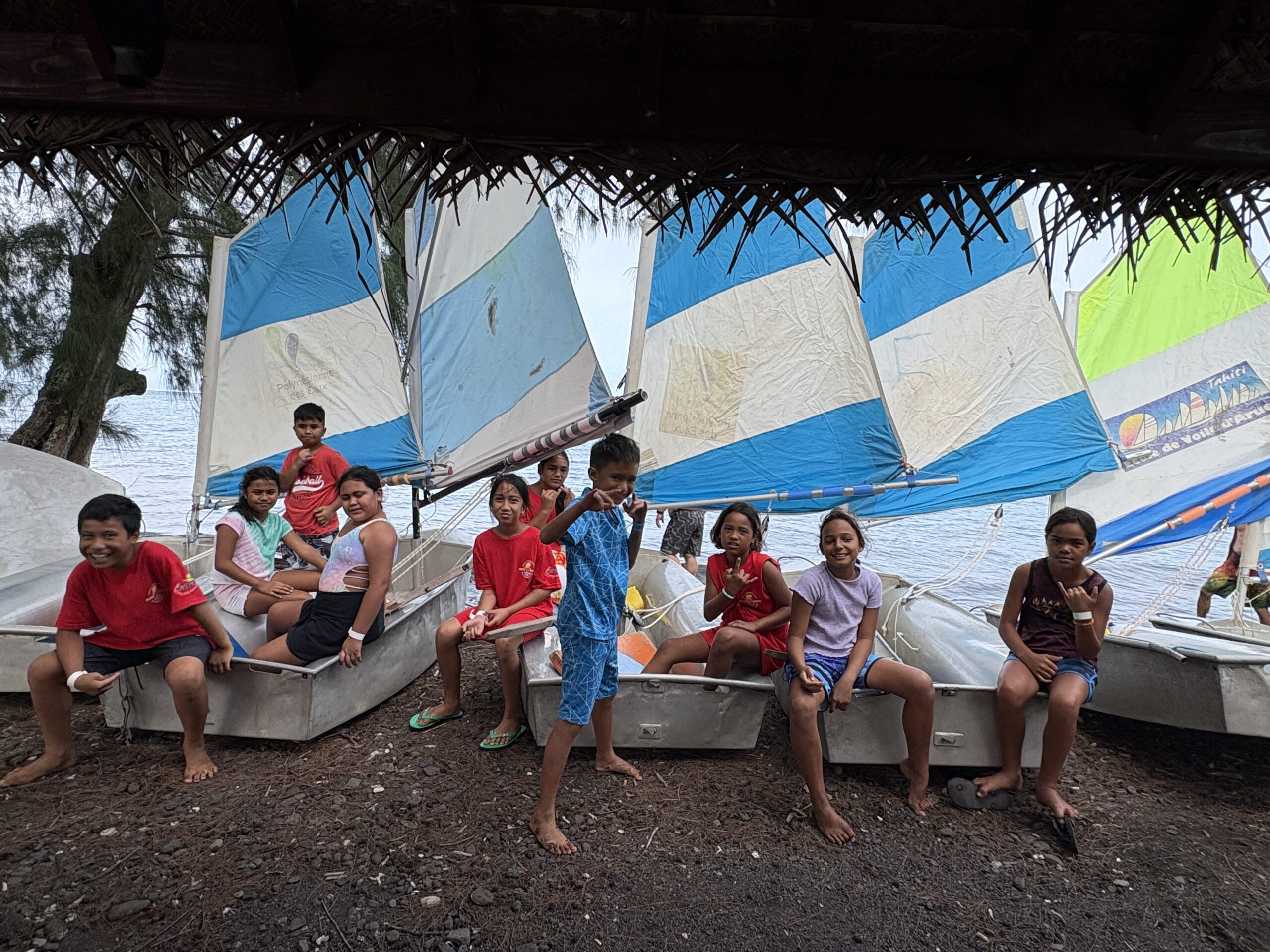
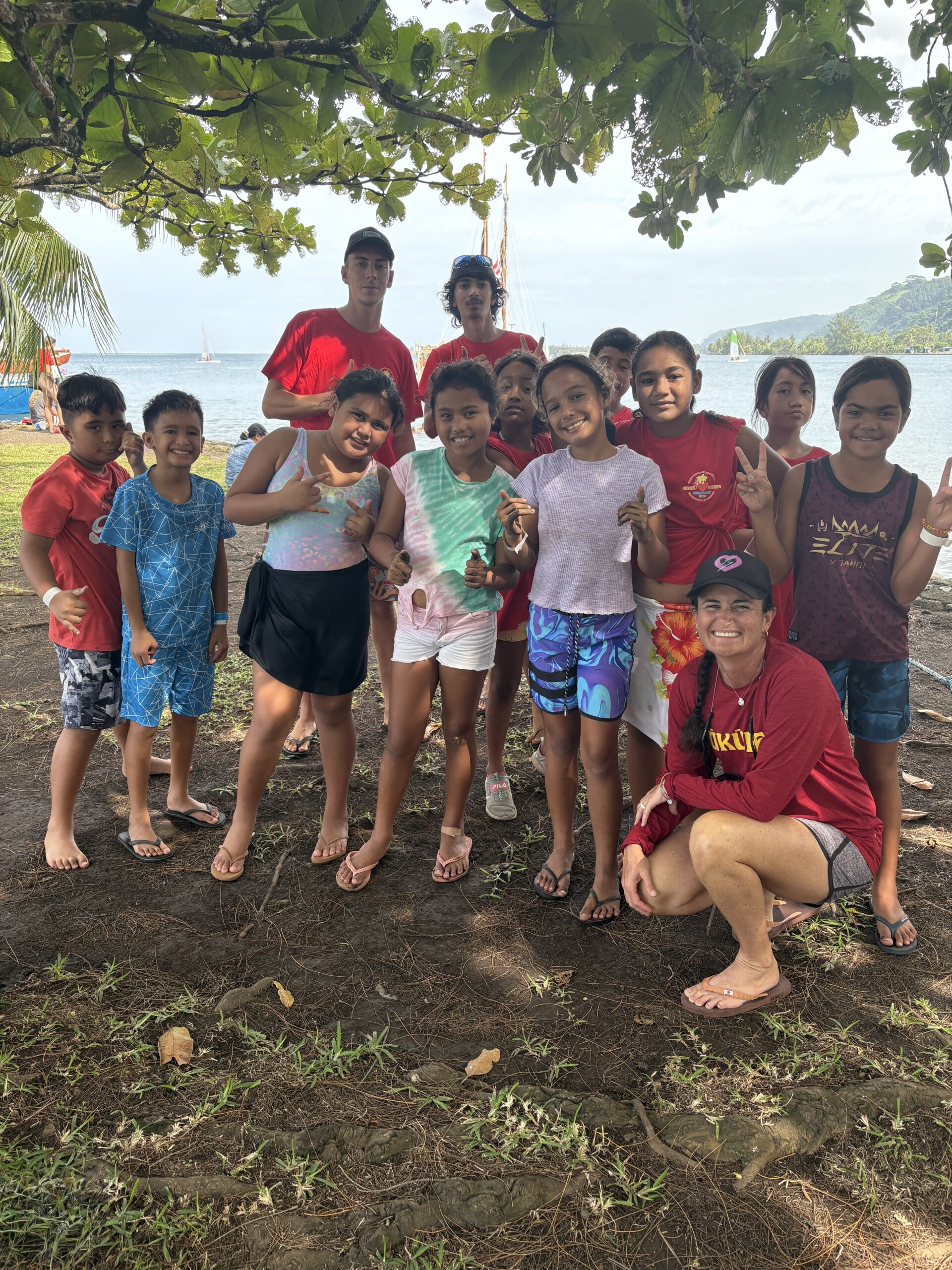
Since the first day and arrival ceremony we have shared a home in the adjacent elementary school with our hosts. We have shared meals, mele, hula, and ori. We have gotten to visit the children of the SAGA program – children identified by social services due to the challenges in their home: violence, alcohol, and drug addiction. They are brought to Motu Ovini for one week in July to feel the love of the community and the healing of the ocean’s powers. They sail, they play, and they connect. We also attended a wa’a symposium in Papeari, across the bay, with the President of French Polynesia as well as some of our most respected navigators of Polynesia: Tua Pittman, Hoturoa Kerr, Titaua from Fa’afaite, and of course our own Pwo, Nainoa Thompson.
Last night Nainoa also gave a powerful speech at the elementary school for the families of our hosts and shared with them about the true pronunciation and meaning of his name, Na’inoa, and how he came to know it during the grief following the loss of his father, Uncle Pinky. It was powerful and followed by a great gifting – a mat full of food. First came the coconuts, then the bananas, sweet potato, taro, cassava, then rambutan, next came a bag – the anticipation built as they struggled to break the chord, finally it was open, and three black chickens were unveiled! Laughter erupted. That was just a warm-up to the next bag – a live little pig! We named it Maxwell II after the first pig brought to Tahiti on the 1976 voyage.
Mataiea is full of so much passion, aloha, laughter, and makana. We are already feeling sadness about leaving this incredibly special place, a place where they unapologetically hold onto their traditions, their language, their songs, and their distant Paoa relatives as well as the canoe that brought us to them. We will forever be changed by this place.